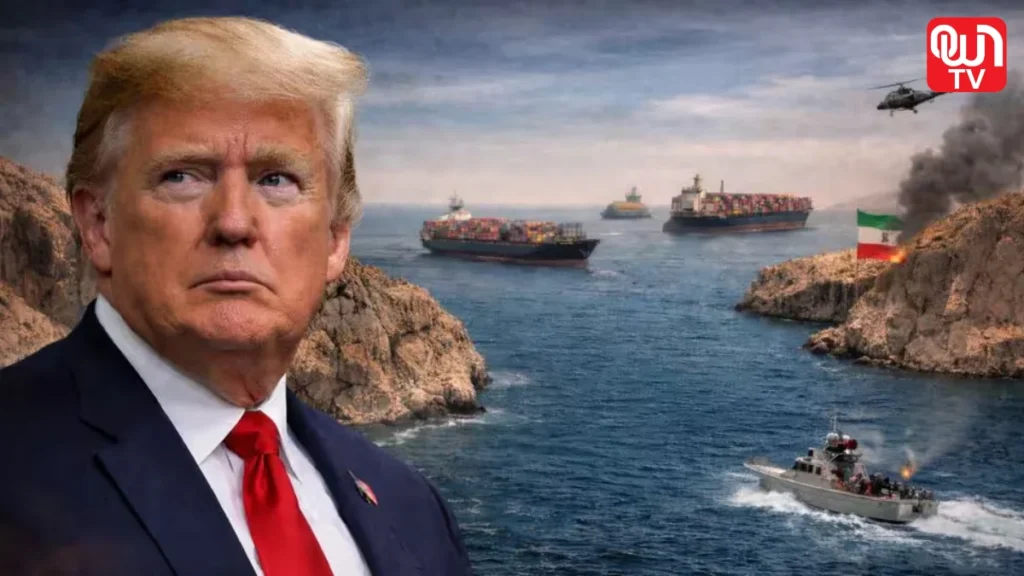
Trump’s Move to Blockade the Restricted Hormuz Strait Sparks Global Oil Shock – Strategic, Economic and Energy Impact on India Explained
The recent announcement by Donald Trump to impose a naval blockade in the Restricted Hormuz region has sent shockwaves across global markets. The Strait of Hormuz, already under tension due to the ongoing 2026 Iran war, is one of the world’s most critical energy chokepoints. Any disruption here has immediate and far-reaching consequences—especially for countries like India.
What Is the Restricted Hormuz Situation?
The Strait of Hormuz connects the Persian Gulf to the Arabian Sea and handles nearly 20% of global oil trade.
In recent weeks, the region has already been partially restricted due to geopolitical tensions, with Iran controlling or limiting ship movements. Now, Trump’s decision to enforce a blockade targeting Iranian-linked vessels further escalates the situation.
While the US claims the blockade is limited to Iranian ports, analysts warn it could still disrupt global shipping routes and increase uncertainty.
Why Is Trump Blocking the Restricted Hormuz?
The blockade follows the collapse of US-Iran peace talks. Washington accuses Iran of threatening global oil supply and imposing unofficial “tolls” on shipping.
The US aims to:
- Cut off Iran’s oil exports
- Maintain control over maritime trade
- Prevent further escalation of nuclear tensions
However, Iran has warned that any enforcement could be treated as an act of war, raising fears of a broader regional conflict.
Global Impact of the Restricted Hormuz Blockade
The immediate effect has been a sharp spike in oil prices, with crude crossing $100 per barrel.
Experts believe:
- Oil could rise to $150–$200 in worst-case scenarios
- Shipping insurance and freight costs will surge
- Global inflation may increase
Stock markets have already shown volatility, especially in Asia, reflecting concerns over energy security.
Read more: Raghav Chadha Removed As Party’s Rajya Sabha Deputy Leader: Is All Well in AAP?
What Does the Restricted Hormuz Crisis Mean for India?
India is particularly vulnerable due to its heavy dependence on energy imports.
1. Oil Supply Risks
India imports over 80% of its crude oil, and a significant portion passes through the Hormuz Strait.
Even if direct supply is not immediately disrupted, global shortages can tighten availability and increase competition.
2. Rising Fuel Prices
Higher crude prices will directly impact:
- Petrol and diesel costs
- LPG cylinder prices
- Transportation expenses
This could trigger widespread inflation across sectors.
3. Inflation and Economic Pressure
As oil prices rise:
- Manufacturing and logistics costs increase
- Food prices may surge
- India’s fiscal deficit could widen
Reports already warn of inflationary pressure and economic instability if the blockade continues.
4. Trade Deficit and Rupee Impact
India’s import bill will rise sharply, putting pressure on:
- The Indian rupee
- Foreign exchange reserves
- Trade balance
5. Strategic Adjustments
India has already started diversifying oil sources, increasing imports from Russia and other regions to reduce dependence on Hormuz routes.
Additionally, India maintains strategic reserves of about 60 days of oil supply, offering short-term relief.
Is There Any Silver Lining for India?
While the situation is risky, India has some buffers:
- Diversified oil sourcing
- Strategic petroleum reserves
- Strong refining and export capacity
However, these are temporary shields and cannot fully offset prolonged disruption.
Conclusion
Trump’s decision to blockade the Restricted Hormuz marks a major escalation in global geopolitics. While the move is targeted at Iran, its ripple effects are global—impacting oil prices, trade flows, and economic stability.
For India, the consequences are significant. From rising fuel prices to inflation and economic pressure, the country faces a challenging period ahead. The crisis highlights the urgent need for long-term energy security strategies, including diversification, renewable energy expansion, and strategic diplomacy.
In a world heavily dependent on a narrow maritime corridor, the Restricted Hormuz crisis once again proves how geopolitics and economics are deeply interconnected.